Last week I looked into burnout – the definition, the reasons and the stages. I argued that it is not a question whether you have burnout in your household or organisation. Rather you should assess at what stage you or your employees are at the burnout continuum. This week I focus on the solution, which is to build resilience at work. So, now you may be asking yourself what’s the recipe for resilience?
Recipe for Resilience
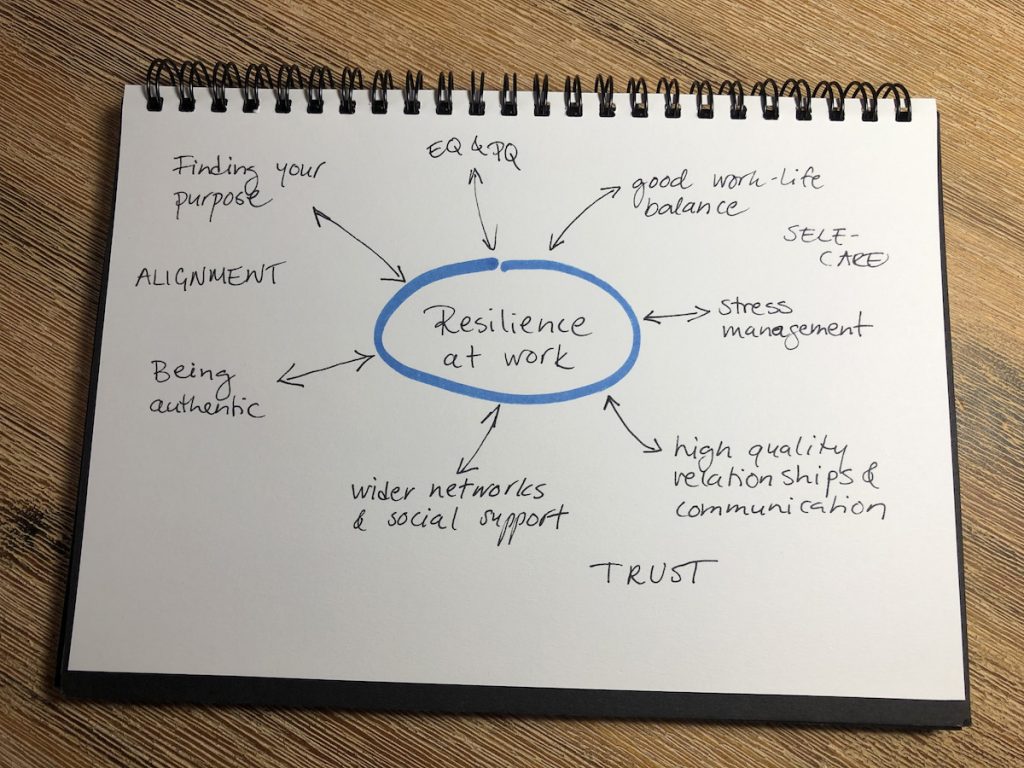
I have identified key ingredients for resilience, which refers to “the ability to bounce back”. These are based on various scholarly articles about wellness and resilience. I have further benchmarked to what has worked and stuck with my clients. The three key ingredients of resilience at work are:
- Alignment
- Self-care
- Trust in Relationships
And these above three key ingredients may be unlocked and sustained with positive intelligence!
Positive Intelligence
Positive Intelligence (PQ) is based on positive psychology, neuroscience, cognitive psychology and performance science. According to Shirzad Chamine PQ is about minimising your self-sabotage, maximising your sage powers and building mental muscle. – Changing your inner critique or negative self-sabotaging thoughts to listening your inner coach resulting in positive emotions, positive actions and overall positive results.
It takes courage and consistent practise. But should you choose to do the work, major shifts will happen. You will find and maintain happiness from within.
In my work supporting people in socio-economic development sector, social entrepreneurship, development cooperation I see that executives, senior management and specialists all tend to have challenges with work-life balance. Many suffer or have suffered from chronic stress with negative mindset and already had a burnout or few. Why wouldn’t they? After all, these employees are driven by altruistic cause, work very hard and often left largely on their own devices.
So, PQ is a foundation for sustainable results. But what are the other key ingredients for resilience at work?
Alignment
The first ingredient is alignment. With alignment I refer to two main things as follows:
- Living with impact, for bigger purpose. People who have found their purpose and aligned their occupation accordingly tend to experience higher satisfaction.
- Good alignment is also about being able to be authentic at work. This has to do with integrity in relation to your own values and being accepted at the work place.
Self-care
The second key ingredient is self-care. With self-care I refer to the following:
- Maintaining a good work-life balance. Having other activities and relationships in life than work related only. Sticking to decent working hours to have energy for family, hobbies, relaxation, healthy lifestyle etc.
- Good and healthy stress management and coping skills, both physical, mental and spiritual. This includes not “living in your head only” but having a connection to your heart, body and soul too.
Trust in Relationships
The third key ingredient is trust in relationships. To be able to trust and to be trusted at work-place is important and includes:
- Good collaboration and assertive communication skills, understanding diversity.
- To have wider occupational and friendship networks for social support.
And then?
The bad news are that many employers do not support resilience by
- appreciating diversity and authenticity
- promoting good work-life balance
- building trust through improving their own and employees’ communication and relationship skills.
The good news are that PQ and resilience skills can be learned.
Should you be a leader, start from your own PQ and resilience. Thereafter apply the knowledge further in your organisation. You will see great returns in employee wellness and commitment, which translates into improved productivity, results and financial bottomline too!
Stop cultivating burnout, start building resilience!
Where would you like to start?

Pauliina Mapatha has twenty years of experience in both the government and non-profit sectors and is a certified life coach. She established her own consultancy company in 2006 and has found her passion for supporting individuals and organisations with change, transformation and wellness.
To contact coach Pauliina click here.