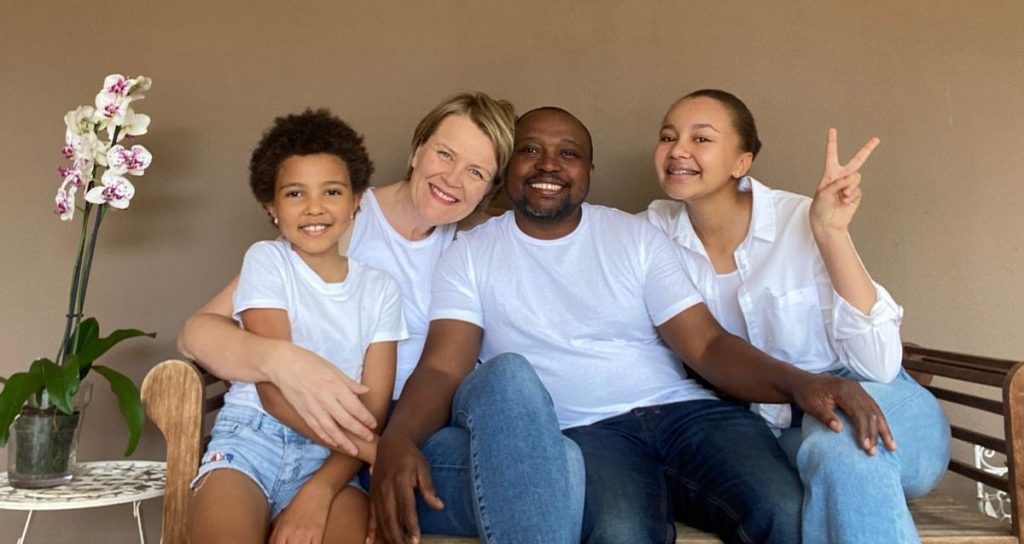
In the expat circles we have some terminology that is not so commonly known. “Lovepat” is one of those. It refers to an individual who has relocated due to romantic relationship, often on permanent basis, to the country of their spouse. So, that means immigration, intercultural relationship, sometimes interracial relationship too with their additional dynamics. – Being a lovepat includes both pains and gains.
You probably guessed right from my surname and complexion; I am a lovepat. A Finn married to South African with two cross-cultural kids based in my husband’s home country, South Africa. Though my journey to being a lovepat started from development studies, career in global education and international development. So, I’ve traversed from being born and raised in Finland to an expat or more specifically an aidpat to being a lovepat.
In this blog I share some common stuff amongst us lovepats through reflecting my own journey. I relocated as a lovepat to my husband’s country in 2005 and been here ever since.
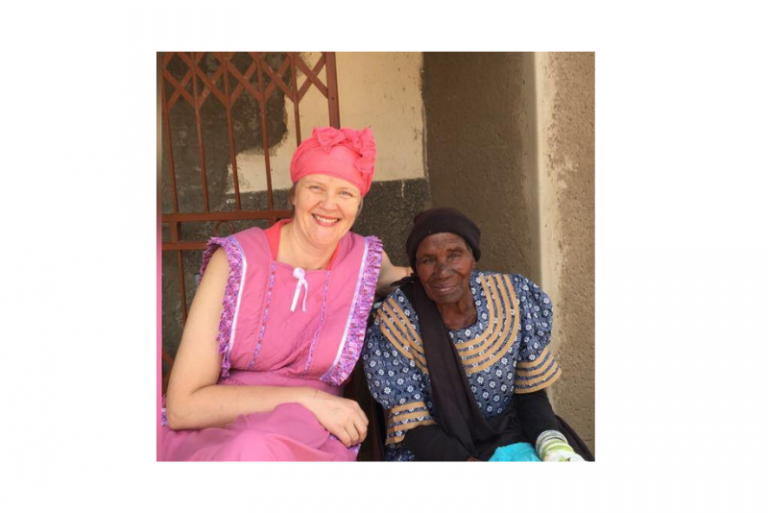
Adaptation and Integration Process
Let’s start from the overall challenge that is cultural adaptation and integration process. In my case I had already experienced few cultural shocks and adaptation processes during my travels, studies and work in different Asian and African countries. I even had two-year experience in South Africa in a bilateral development cooperation program. So, I did not expect any major challenges. But chee, how wrong was I. This relocation as a lovepat happened parallel to becoming a mom. I moved to South Africa to be together as a family at least during the maternity leave, which ended up being a permanent move. We figured that we would be better of as a couple in South Africa when it comes to e.g. language and professional work opportunities to both of us.
From Honeymoon to Rejection Phase
The beginning was exciting. We were building our home together for us and our first born. This “honeymoon phase” lasted few months. But then the reality kicked in, I met my boundaries as a mom at home and the limited independence, which lead to “rejection phase”.
Bang! In this phase I was truly home sick, sad if not angry. I felt lonely, missed my previous life. My husband worked from Monday to Friday and was happy to chill at home in the evenings while I yearned for adult conversations, more social connection and fun. The local friends that I had were also working and many had relocated. I remember the monthly thoughts of packing my bags and returning to Finland.
Adjustment Phase
Eventually the process moved forward to an adjustment phase with its own ups and downs, backslides and jumps forward. First strategy that helped in adjusting was to find new friends amongst both local and international people. My best new friend was another expat-mom, whose son was same age than our daughter. Someone who really got me!
Second great strategy was to organise some quality me-time. We recruited domestic help for Tuesdays and Thursdays. This arrangement gave me an opportunity to swim at the gym and enjoy shopping without the baby.
My husband and his wider family really supported me too. We built and maintained rather wide social network including time in the village with extended family to expat circles in the city.
I had largely recovered, but something was still lacking…
Further Recovery and Integration
The key ingredient in adaptation and actual integration for me was employment. This truly led to and fast-tracked my recovery phase. Work is big part of my identity and hence I found the period of being home extremely challenging, even if that was just one and half a year including my maternity leave. In my case I set up my own consulting company and got first assignments through my international networks in donor funded programs. My Program Cycle Management / Logical Framework Approach and proposal writing skills got me going.
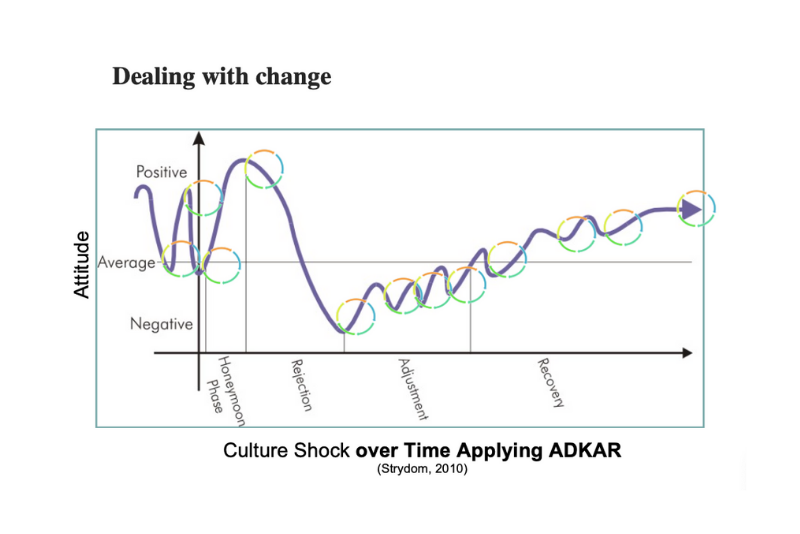
The below diagram of Amanda Strydom from her Coaching with Impact Pack illustrates these cultural adaptation phases in relations to one’s positive or negative attitude, the highs and lows.
I’d say that I have travelled along these curves several times. It is not a once of roller-coaster! Any shock or change will initiate a new adaptation process. The birth of second child, death of your loved one, career change, global pandemic…
Challenges and Opportunities
Intercultural Awareness and Communication
Intercultural awareness and communication are part of the overall adaptation process. In our case we share a language, English and hence the starting point for intercultural communication, which is to have a common language, was sorted. However, language is only small part of the communication. The different cultural paradigms and norms are another dimension altogether that may cause misunderstandings or confusion.
We tend to have lengthy discussions if not debates only to find out that we agree: “But why did you not say so right away.” – However, interpersonal differences play a role here too. Just like in any other relationship.
In our case the language is English, the official language of South Africa. Not mine, not his. So, the language of the relationship is somewhat on equal footing. On the hindside should we have chosen to speak our mother tongues to each other, we could have learned them decently by now. This would have provided an opportunity for deeper connection with our extended families and integration in our respective communities. – Hey, do not get me wrong here. I hear quite a bit of Sepedi too!
Grief of Loss & Connection to Home-Home
Even after the adaptation and integration to South Africa I miss “home-home”. This is a kind of a longing, feeling compromised, grief of a loss, if not jealousy sometimes. Living far from my own folks, traditions, seasons etc. is tough sometimes.
One partial cure for this home sickness was to agree and arrange annual trips to Finland. Though, this also led to a compromise when most vacation days and budget was spent visiting relatives instead of actual rejuvenation as a couple and our nuclear family.
Another tip is to bring along pieces of your own culture and integrate it in your international life. In our case the one that sticks best for the whole family is Finnish Christmas Eve. So, every year we do the Finnish Christmas Eve and South African Christmas Day.
As Internet connectivity and my social media skills have improved it is much easier to tackle with home sickness. I keep in touch with my Finnish and international tribes on weekly if not daily basis. This has really changed things. In my first field missions there was not Internet!
Parenting Cross-Cultural Kids
Parenting cross-cultural kids is a learning curve on its own. We thought that we were raising our children to know, identify with and embrace two cultures and languages. Only to find out that their cultural identities and preferences are something different from ours.
What I have learned so far is to take the time and effort to share your own culture, language and roots with your children from early age while concurrently be open-minded and curious to embrace them as they form their own cultural identities.
Standing Out
As a mixed-race couple we stand out of the crowd. So do our daughters. This results in getting too much attention. My surname is always questioned and wondered. To pay with my debit or credit card I need to explain that yes, that is my surname. Yes, I am married to Northern Sotho. Yes, my husband is black. Or if accompanied with my daughters. Yes, they are my daughters. No they are not coloured…
Positive mindset really helps here. I try my best to respond to these questions and comments with love and humour. After all, I live in a country where inter-racial marriages were illegal. I also come from an extremely homogenous country that ranks high in racism.
Love, Common Ground, Our Thing
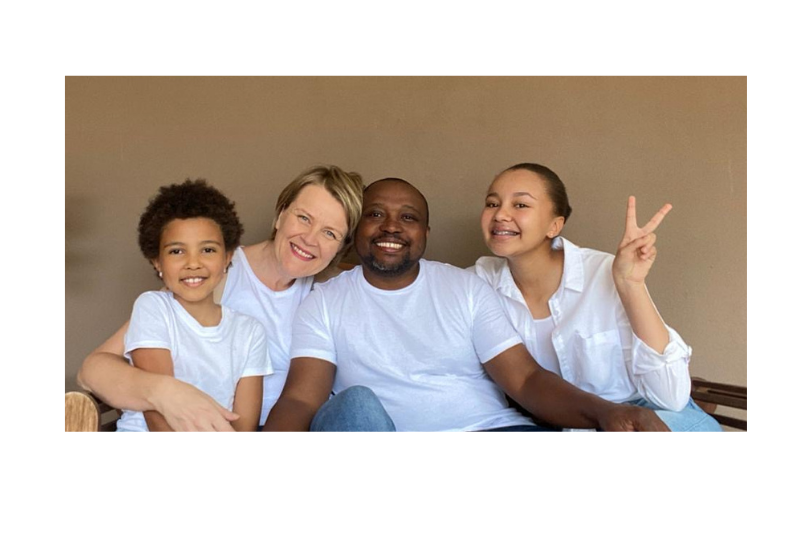
To continue enjoying my lovepat journey I keep reminding myself the reason, why did I choose this lifestyle. For me it is first and foremost love and building a family. In addition to that this choice has provided me new experiences and opportunities both personally and professionally. And I love variety!
It has been important to learn each others cultures but focus on finding the common ground instead of the differences. What unites us despite our different backgrounds.
Some of the things that connected us from the beginning were: work, conversations, love for Afro-Jazz music and values or principles in a relationship. Our home is some sort of combination or mix of both cultures and compromises if not innovations in-between. We converse in Finglish (Finnish flavoured English) and Sepenglish (Northern Sotho/Sepedi flavoured English), while our children teach us proper English. We fit both our cultures and other world kitchens in our weekly menu.
This is not to say that there are no challenges. There are. And there will be. Just like in any other marriage or relationship. Intercultural and inter-racial marriages take some extra courage and commitment from both parties in understanding each other and finding the common ground. Having and agreeing on some key principles and expectations upfront will be very helpful. Loving support without meddling in-between from both sides of your families and wider community make things easier too.
How aware are you about cultural differences in your relationship?
How good are you in intercultural and interpersonal communication?
Do you stare or ask many questions from mixed-race couples or individuals?

Pauliina Mapatha has twenty years of experience in both the government and non-profit sectors and is a certified life coach. She established her own consultancy company in 2006 and has found her passion for supporting individuals and organisations with change, transformation and wellness.
To contact coach Pauliina click here.